
Acoustic concepts / 9 min read
Sabine vs Norris–Eyring Reverberation Time
Sabine and Norris–Eyring are statistical reverberation-time methods. They use the same room geometry and absorption data, but treat average absorption differently and can produce meaningfully different results in more absorptive rooms.
By Joshua Winning — Founder & Lead Engineer at Acouso
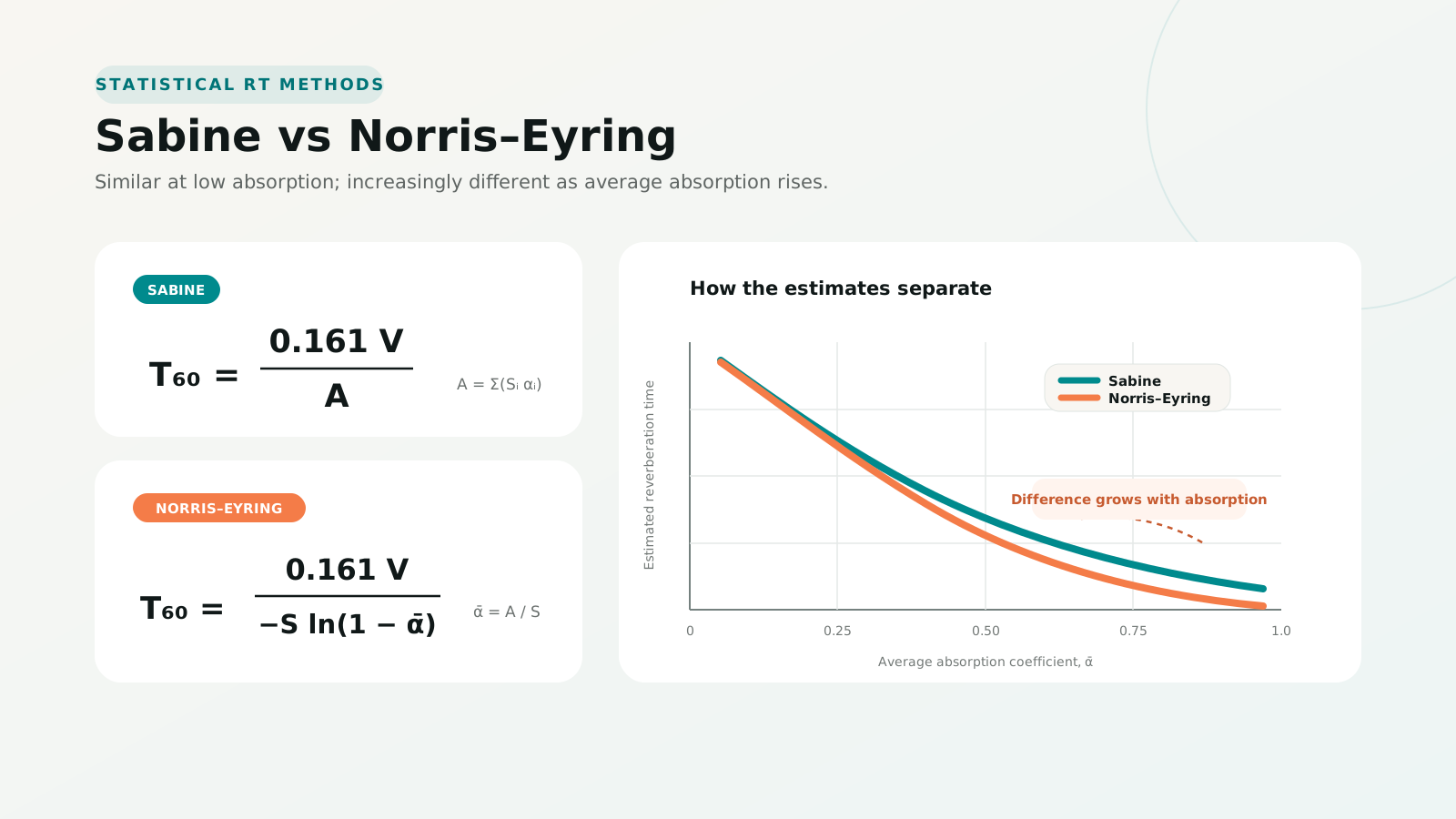
The Sabine equation
Sabine relates room volume to total equivalent absorption area. It is widely used because it is transparent, easy to calculate by frequency band, and useful for early comparisons when the diffuse-field assumptions are reasonable.
- T₆₀
- Reverberation time in seconds
- V
- Room volume in cubic metres
- A
- Total equivalent absorption area in square metres
- A = Σ(Sᵢαᵢ)
- Sum of each surface area multiplied by its absorption coefficient
The Norris–Eyring equation
Norris–Eyring uses the room's total surface area and its area-weighted average absorption coefficient. The logarithmic term changes the behaviour as average absorption rises.
- S
- Total room surface area in square metres
- ᾱ
- Area-weighted mean absorption coefficient, A divided by S
- ln
- Natural logarithm
- V and T₆₀
- Room volume and reverberation time as defined above
Why the methods are close at low absorption
For a small average absorption coefficient, the logarithmic term can be approximated as −ln(1 − ᾱ) ≈ ᾱ. Since A = Sᾱ, the Norris–Eyring denominator then approaches A and the equation approaches Sabine.
As absorption rises, −ln(1 − ᾱ) grows faster than ᾱ. Norris–Eyring therefore produces a larger effective denominator and a shorter reverberation-time estimate than Sabine for the same geometry and coefficients. This mathematical behaviour does not make it universally more accurate; both methods still depend on statistical, diffuse-field assumptions.
Area-weighted worked example
Consider an 8 m × 6 m × 3 m rectangular room. Its volume is 144 m³ and its total floor, ceiling, and wall area is 180 m². At one frequency band, assume the area-weighted surface assignments produce 36 m² of equivalent absorption, so ᾱ = 36 / 180 = 0.20.
Sabine gives 0.161 × 144 / 36 = 0.64 s. Norris–Eyring gives 0.161 × 144 / [−180 ln(0.80)] = 0.58 s. The difference comes from the method, not a change to the room inputs. Repeat the calculation independently for every frequency band because each material coefficient changes with frequency.
Open the free calculator, build a room, then switch the method selector between Sabine and Norris–Eyring to compare your own six-band result.
Which method should you choose?
Sabine is a useful transparent baseline and remains common for early design estimates, particularly at modest average absorption. Norris–Eyring is useful when you want to examine how a statistical estimate changes as average absorption becomes higher.
Neither equation fully resolves uneven absorption, non-diffuse decay, coupled spaces, source and receiver position, room modes, scattering, diffraction, or complex geometry. The method should match the question, available inputs, and required confidence rather than being selected because one name sounds more advanced.
| Consideration | Sabine | Norris–Eyring |
|---|---|---|
| Core input | Equivalent absorption area A | Total area S and average absorption ᾱ |
| Low absorption | Closely agrees with Norris–Eyring | Approaches Sabine |
| Higher absorption | Longer estimate for the same inputs | Shorter estimate because of the logarithmic term |
| Strength | Simple, transparent baseline | Shows statistical high-absorption behaviour |
| Shared limitation | Assumes sufficiently diffuse statistical behaviour | Assumes sufficiently diffuse statistical behaviour |