
Acoustic concepts / 7 min read
What Is Reverberation Time and RT60?
Reverberation time describes how quickly sound energy decays after a source stops. RT60 turns that decay into a useful room-acoustic measure, but its meaning depends on frequency, method, and context.
By Joshua Winning — Founder & Lead Engineer at Acouso
What a 60 dB decay means
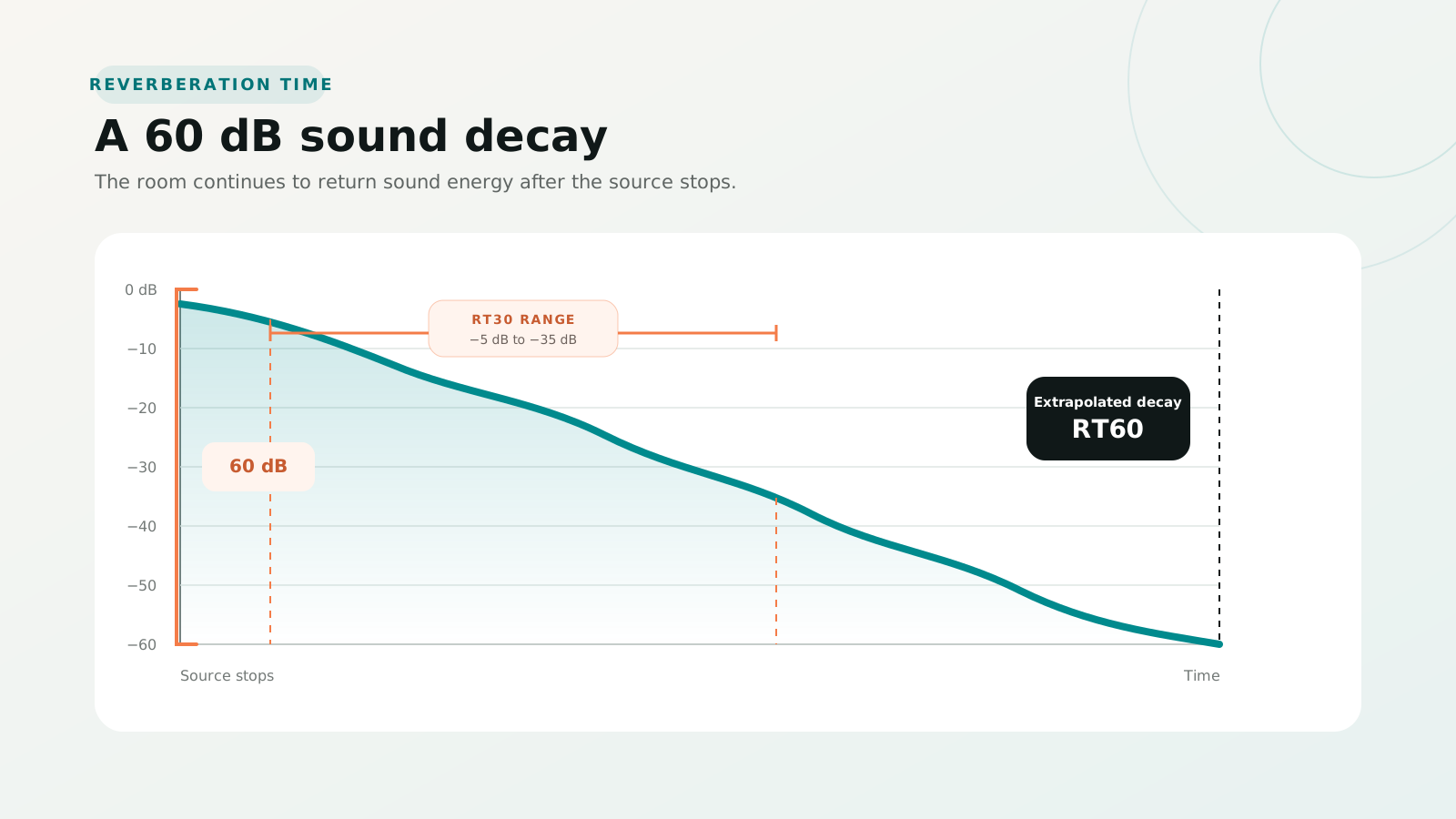
RT60 is the time required for the sound level in a room to fall by 60 decibels after the sound source stops. A 60 dB reduction represents a very large loss of sound energy, so it is a useful common reference for comparing how live or controlled different rooms may feel.
Longer reverberation times can reduce speech clarity and make activity noise accumulate. Very short reverberation times can be helpful for speech, concentration, or recording control, although the appropriate result depends on the room use, volume, background noise, and design intent.
Why reverberation varies by frequency
Materials do not absorb every frequency equally. Carpet may absorb useful amounts of mid- and high-frequency sound while providing much less absorption at low frequencies. A curtain, ceiling panel, wall lining, or occupied seating area also has its own frequency-dependent behaviour.
That is why a single RT60 number can hide important information. Room-acoustic estimates and measurements are normally reviewed in frequency bands. The Acouso calculator reports 125, 250, 500, 1000, 2000, and 4000 Hz so the shape of the decay response remains visible.
The inputs behind an RT60 estimate
Statistical reverberation formulas combine room volume with the area and absorption coefficient of each surface. Multiplying a surface area by its absorption coefficient gives its equivalent absorption area; adding the surfaces gives the room total for each frequency band.
A larger room generally stores more sound energy and therefore tends toward a longer reverberation time. More effective absorption reduces the estimate. Because both geometry and absorption matter, changing a finish and changing a room dimension are not interchangeable design moves.
Try the free calculator to assign finishes to all six room surfaces, add treatment areas, and compare Sabine with Norris–Eyring across six octave bands.
Estimated RT60 is not a measurement
A calculator predicts reverberation from a simplified room model. A field or laboratory measurement observes the decay in a physical space using controlled sources, microphones, procedures, and evaluation ranges.
In practice, RT20 and RT30 are commonly obtained from 20 dB or 30 dB portions of a measured decay curve and extrapolated to the equivalent 60 dB decay time. This helps when the available signal-to-noise range does not support a clean direct 60 dB observation. ISO 3382-2 provides measurement context for reverberation time in ordinary rooms.
Targets, interpretation, and limitations
Reverberation targets are typically tied to room use, volume, frequency range, and a particular brief or standard. A target line is therefore a design reference, not proof that a room complies or will perform as intended.
Simple statistical estimates do not describe source and receiver positions, individual reflection paths, room modes, diffraction, scattering, workmanship, furnishings, occupants, or irregular geometry in detail. Use them for early exploration, then select measurement or more detailed modelling when the decision requires it.