
Room analysis / 3 min read
Coming to Acouso-ROOM: acoustic ray analysis in Revit
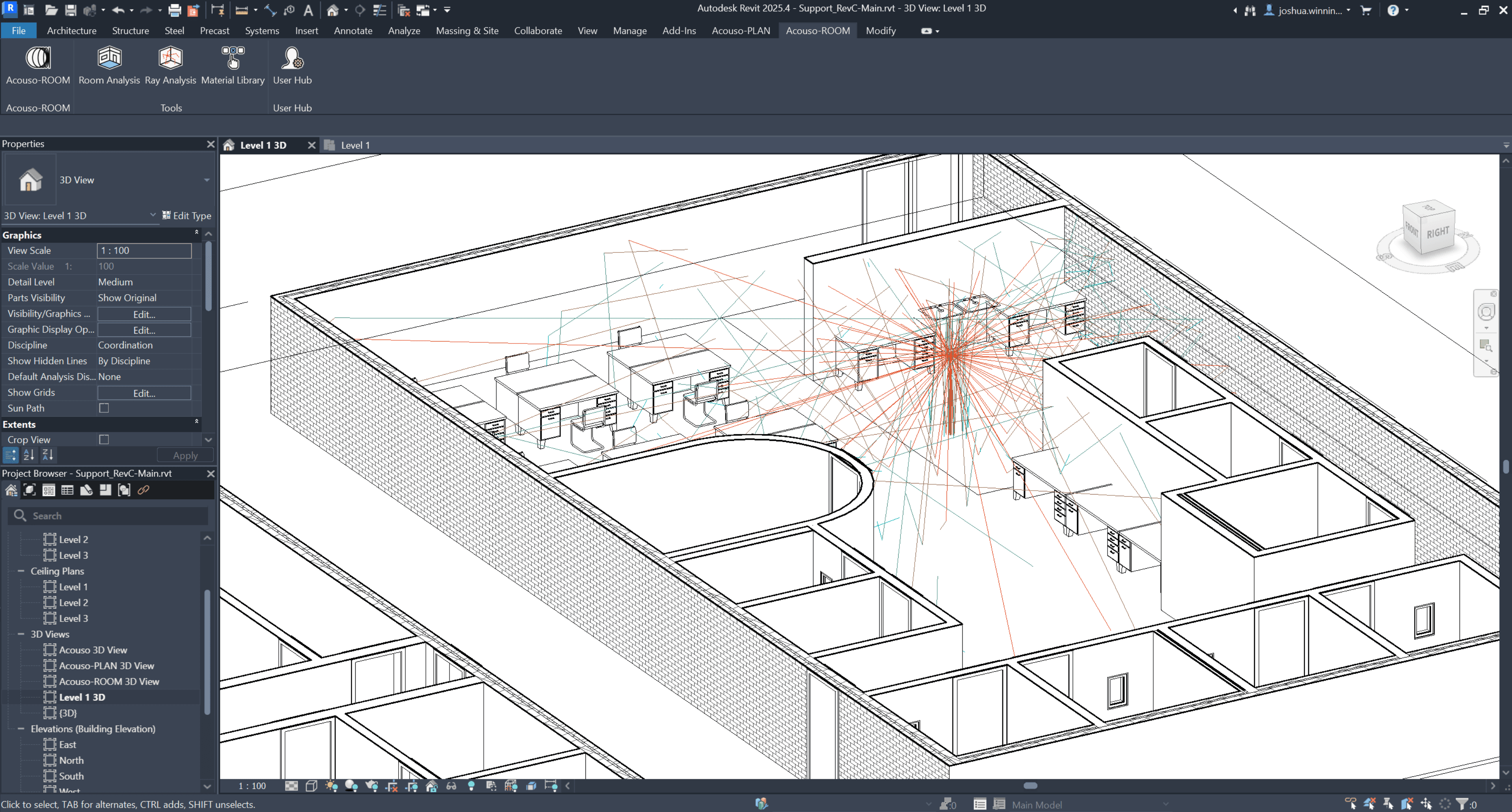
Acoustic ray analysis is coming to Acouso-ROOM, bringing a richer way to explore sound propagation inside Revit. The upcoming functionality connects visualisation, predicted acoustic indicators and illustrative listening previews with the model you already use. We are inviting acoustic consultants, designers and Revit users to register their interest in early access and help shape the workflow.
By Joshua Winning — Founder & Lead Engineer at Acouso
Building on reflection analysis
Acouso-ROOM already provides reflection visualisation and source-to-receiver workflows. These help you inspect sound paths in the context of room geometry. The next stage extends that foundation into a more detailed acoustic study, connecting the paths you can see with additional predictions and ways to compare design options.
This is upcoming functionality, not a description of everything included in the current download. Existing reflection tools remain distinct from the advanced acoustic ray analysis preview. Early-access features and outputs may change as the workflow is tested, and this announcement does not set a release date or confirm future product-tier availability.
Visualise and compare acoustic behaviour
The preview is being developed to trace reflections in 3D, inspect early reflection paths, compare listening positions and test source direction within the Revit model. Spatial heat maps provide another way to explore how predicted conditions vary across a room, alongside the geometry and materials that influence them.
Planned outputs include predicted room decay, C50/C80 clarity, sound levels and speech transmission index (STI). Together, these give project teams different views of a design question: what changes when a source moves, a listening position changes, or a surface treatment is adjusted?
These are model-based predictions. Their interpretation depends on the geometry, material inputs, source and receiver configuration, and analysis assumptions. They support professional assessment rather than replacing measurements, validation or acoustic judgement.
Listening previews and early access
Listening preview / auralisation adds an illustrative way to hear and compare predicted acoustic behaviour. Alongside visualisation and numerical outputs, it can help make the consequences of design choices easier to discuss with a project team. It is not a guaranteed reproduction of how the finished room will sound.
Register your interest through the acoustic ray analysis early-access page. Invitations will be released in stages, with professional Revit workflows prioritised initially. Registration does not provide immediate access. Tell us about the acoustic questions you want to investigate so that testing can focus on useful, real project decisions.