
Acoustic concepts / 9 min read
Statistical, Ray-Tracing, and Wave-Based Room Acoustics
Room-acoustic methods answer different questions. Statistical formulas estimate overall decay, ray methods follow spatial reflection paths, and wave-based methods resolve pressure fields and interference. A useful workflow chooses the right level of physics for the decision.
By Joshua Winning — Founder & Lead Engineer at Acouso
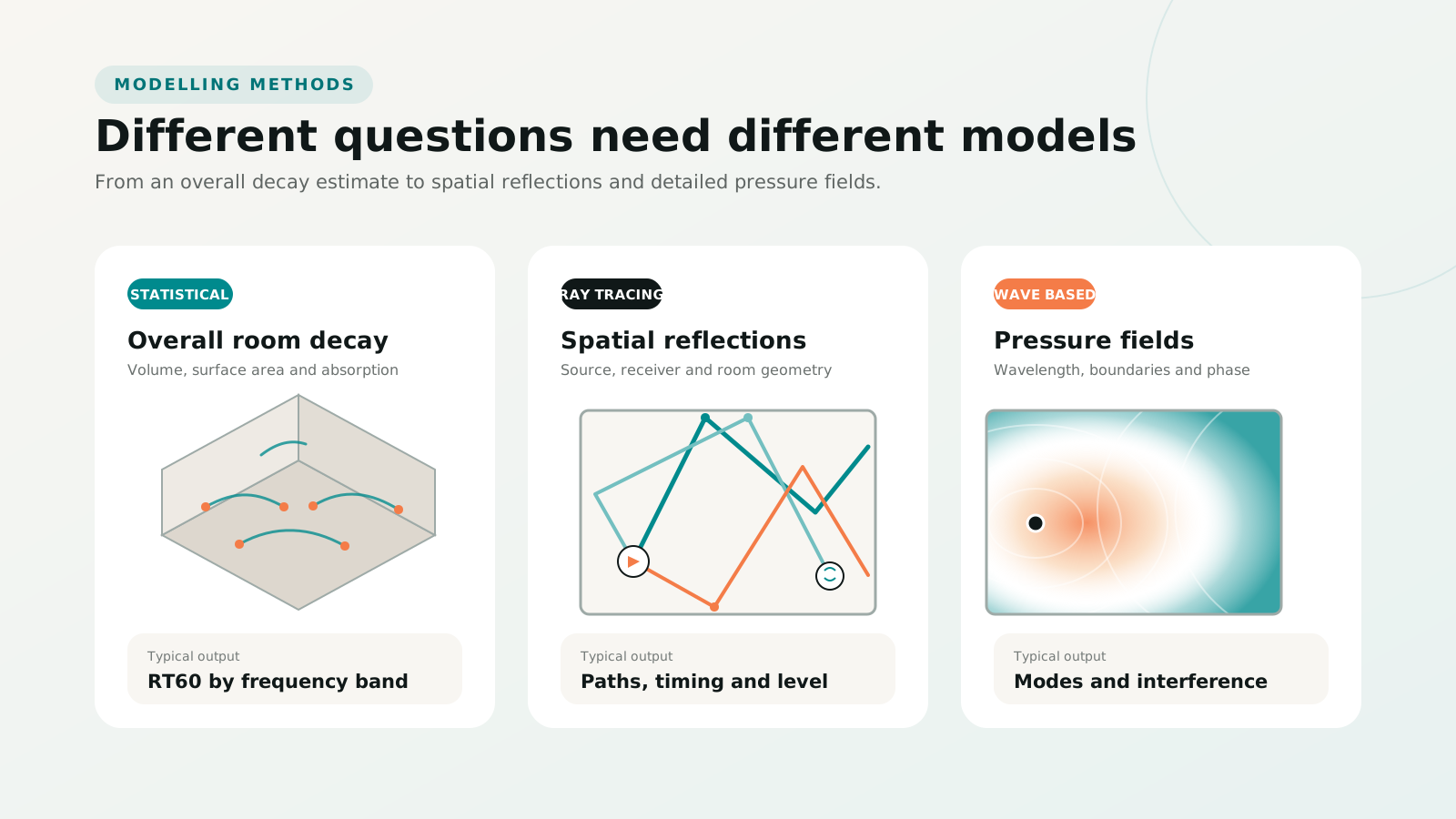
Statistical reverberation methods
Sabine and Norris–Eyring reduce a room to volume, surface area, and frequency-dependent absorption. Their output is compact: typically a reverberation-time estimate for each frequency band.
That makes statistical methods fast, legible, and valuable for early material or treatment comparisons. They do not know where a source or receiver sits and do not describe individual reflection paths, interference patterns, local pressure variation, or room modes.
Geometrical ray methods
Ray-based methods treat sound propagation as paths travelling from a source and interacting with surfaces. They can retain source directivity, receiver position, reflection order, travel time, surface absorption, and—in more developed models—scattering and diffraction approximations.
These methods can reveal direct sound, early reflections, spatial coverage, and energy arriving at different receiver positions. Their geometrical approximation is generally more useful when wavelengths are small relative to the important room features, so care is needed toward lower frequencies.
Wave-based numerical methods
Wave-based approaches solve for an acoustic field rather than tracing independent paths. Depending on the formulation, they can represent interference, standing waves, room modes, phase, diffraction, and spatial pressure variation.
The additional physical detail requires more geometry preparation, material information, numerical resolution, computing time, and interpretation. Because mesh or discretisation requirements tighten as frequency rises, full-wave room models can become expensive at high frequencies or over large spaces.
How the approaches compare
The methods should not be arranged as a simple ladder from inaccurate to accurate. They have different inputs, resolution, cost, and assumptions. A quick statistical estimate may be more useful than a detailed simulation when the design question is simply how much absorption to add; a spatial source-to-receiver problem needs a different model.
| Feature | Statistical | Ray-based | Wave-based |
|---|---|---|---|
| Typical inputs | Volume, areas, absorption | Geometry, source, receivers, surface properties | Geometry, boundary conditions, source, numerical domain |
| Typical outputs | Band RT60 estimates | Paths, arrivals, energy, spatial metrics | Pressure, phase, modes, interference |
| Source/receiver aware | No | Yes | Yes |
| Room modes and interference | No | Not inherently | Yes |
| Computational cost | Very low | Moderate and scalable | Often high, increasing with frequency and size |
| Useful role | Early decay and treatment comparisons | Spatial reflections and coverage | Low-frequency and detailed field behaviour |
Why hybrid workflows are practical
A hybrid workflow may use wave-based analysis where modes and interference dominate, then use geometrical methods where a ray approximation is efficient. Statistical estimates can remain valuable for screening options, checking orders of magnitude, and communicating material decisions.
Acouso-ROOM focuses on room-acoustic analysis inside Revit. Acouso-PLAN has a distinct early-access focus on acoustic assessment, markups and communicating design requirements. The appropriate analysis method still depends on project stage, frequency range, and the decision being made.
The browser calculator intentionally implements statistical Sabine and Norris–Eyring estimates only. Ray and wave methods require spatial inputs and modelling choices beyond this early-exploration tool.